

Introduction
Flower bulbs are an incredibly versatile addition to any type of garden. Typically, they are used in perennial borders, natural woodland gardens, naturalized in meadows and orchards, in containers, or for indoor forcing to enjoy the blooms out of season. In fact, nearly 50% of all bulbs sold are planted in containers. Many months of continuous bloom are possible.
Bulbs are not just about the bloom; the Yellow Fritillaria with its dramatic architectural structure is a good example of how foliage can also play an important role in many garden situations. Bulbs are beautiful and fun to grow.
You will be most well-rewarded for your efforts if you respect the cultural requirements for your bulbs when you plant, including their various requirements for acceptable climate, soil, water, and drainage. The information provided with each variety including zones and hardiness, blooming height, spacing, depth, bloom time, and variety specialty should be treated as general guidelines since results will vary by climate, soil type, fertility, bulb depth, and whether or not you mulch.
Planting Bulbs in the Garden
Fall planted bulbs for spring blooms are alliums, amaryllis, anemeone, crocus, daffodil, freesia, hyacinth, iris, ixia, lily, muscari, peony, ranunculus, sparaxis, and tulip.
Spring planted bulbs for summer blooms are asiatic lily, begonia, calla lily, canna lily, crocosmia, dahlia, elephant ear, gladiolus, oriental lily, tiger lily, peony, ranunculus, and shamrock.
Soil
Bulbs prefer soil that is not too acidic. A soil analysis will tell you if your soil is within the optimal pH range of 6.0–7.5. Soil below 6.0 is too acidic which can be adjusted by adding garden lime. A pH over 7.5 is too alkaline and can be adjusted by adding soil sulfur.
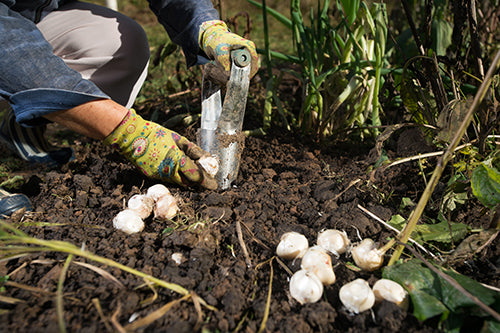
Prior to planting, add a high phosphorus fertilizer to the soil. Use a hand bulb planter or a bulb auger to easily dig a hole. When planting bulbs, place the flat end of the bulb down and the pointed side up. If you are in doubt, put the bulb on its side and it will right itself. If you have gophers, you may want to plant your bulbs inside a gopher wire barrier (see our Gopher Control Products).
Watering
Bulbs require good drainage, but can tolerate some heavy soils if planted on slopes. Bulbs sitting in soggy soil may rot. Deep watering is best for bulbs. If drainage is good, a soaking down to a foot deep is not excessive. Give your bulbs a deep soak when buds first appear and make sure they receive consistent water while in bloom and until leaves turn brown. Avoid heavy overhead watering, which can harm or knock down blooms; it’s best to use drip irrigation. Fertilize when shoots first appear with a liquid fertilizer and again after bloom, but before dormancy.
Cuttings
When cutting flowers, leave the foliage, which makes food for the bulb that is needed for growth and production. Snip off spent flowers as soon as they are past their prime.
Forcing Bulbs Indoors

Dormancy
Bulbs must be dormant for forcing; purchased bulbs are already dormant, but any bulb that has already gone through its dormancy period during summer may be used. For forcing bulbs indoors use only named bulbs. Bulbs in cheaper mixtures are not forcing varieties and can seldom be forced with satisfactory results.
Potting Up Bulbs
Early potting is imperative to achieve abundant root growth. All potting should be completed before the middle of November. In general, pot up bulbs by mid-September for late-December blooms, by mid-October for February blooms, and by mid-November for March blooms. All bulbs will do better in soil rather than in only water in pebbles. Do not plan on re-using bulbs forced in a water vase; they will use up all their nutrients for this one bloom (instead, you can plant them in the garden, but they may not bloom again for several seasons).
A good planting medium is a mixture of 2 parts sandy loam, 1 part coco peat or good quality compost and 1 part sharp sand or perlite (just make sure you are providing excellent drainage along with good moisture retention).
Plant flower bulbs at a depth where the tops are close to the soil surface. The soil level within the pot must be ½” to ¾” below the rim of the pot to permit watering. After potting, soak thoroughly and place the pots in their location for cool storage. Label each pot with the cultivar, planting date, and date to bring indoors.
Cool Storage for Root Development
Bulbs must develop roots before they may sprout, and if they are not sufficiently developed, your blooms may just fall off before they even open or the plant will not be able to support flowers and stems. So be patient and provide plenty of time for this important stage.
Sufficient root growth takes 10 to 15 weeks. For early spring bloomers, provide at least 12 weeks, and for later spring bloomers, allow at least 15 weeks of root development. Time will vary according to conditions, so it is best to use these numbers as guides but actually take a look at the root development in the pot to make a decision. If you see roots emerging from the drain hole, you are in good shape.
Use the following chart as a guideline for cool storage length:
- Tulips 14–15 weeks
- Crocus 4 weeks
- Hyacinths 10–12 weeks
- Snowdrops, Scilla 6–7 weeks
- Narcissus 12–15 weeks
- Muscari 12–15 weeks
Place pots in a dark location where the temperature is optimally between 35°F and 55°F. Freezing will not hurt these bulbs, but heat may. Garages, cellars, and sheds are great places to do cool storage. Be sure to keep watering them; do not allow the pots to dry out, but all require good drainage, especially if they are out in the rain. If placed outdoors, set on level ground, free from water. If exposed to winter rains, place a layer of bark or gravel beneath pots for additional drainage. In cold climates, cover pots with 6” to 8” of leaves or with soft non-compacting mulch such as vermiculite, hay, fir, birch or peat moss. Cover this with about 3” or 4” of earth to weigh it down.
Sprouting
The pots may be brought into the house as desired whenever root growth is abundant. Plenty of roots showing through the bottom of the pot will indicate sufficient root growth. If succession blooming is desired during the winter, pot up the bulbs at one time then bring them inside at intervals of 2 to 3 weeks. When brought indoors, the pots must initially be kept out of direct sunlight at a temperature not over 65°F, which induces the stems to lengthen. If placed in higher temperatures, the flowers are likely to open within the folded leaf. Provide plenty of water during this development period. A rule of thumb for forcing is that bulbs will flower approximately thirty days after they become visible. You can decide at that time whether to increase or decrease the temperature slightly to change the rate of growth.
Blooming
Once the bulb has produced a growth about 3” to 4” it may be exposed directly to light (on the coolest window sill you have) until you see the bloom color begin to emerge. Regularly turn the pot for even light exposure. At that time, move to a cool spot with indirect light until blooming is over. After the flowers bloom, cut back the flower stems and place in a cool sunny spot outdoors, gradually decreasing the watering until the leaves die. Fertilize. Bulbs can then be planted in the fall, but usually take about 2 years to flower again.


